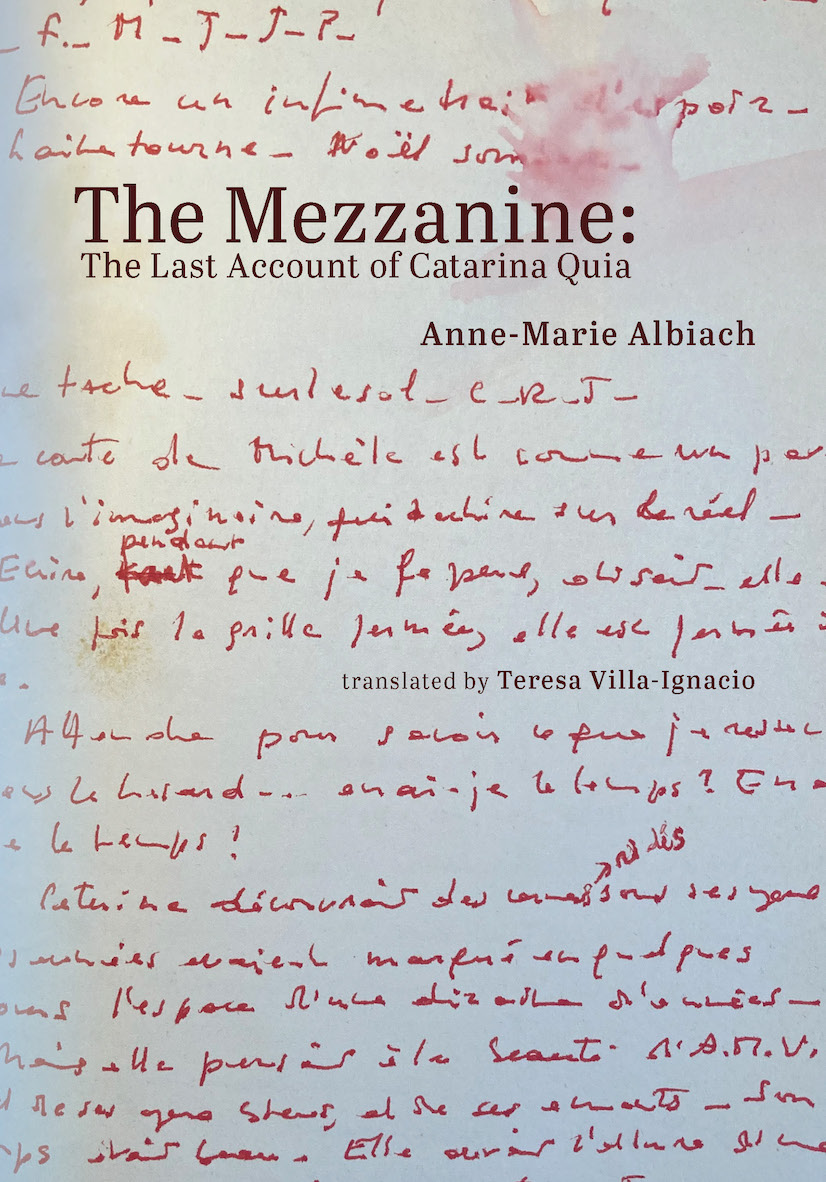
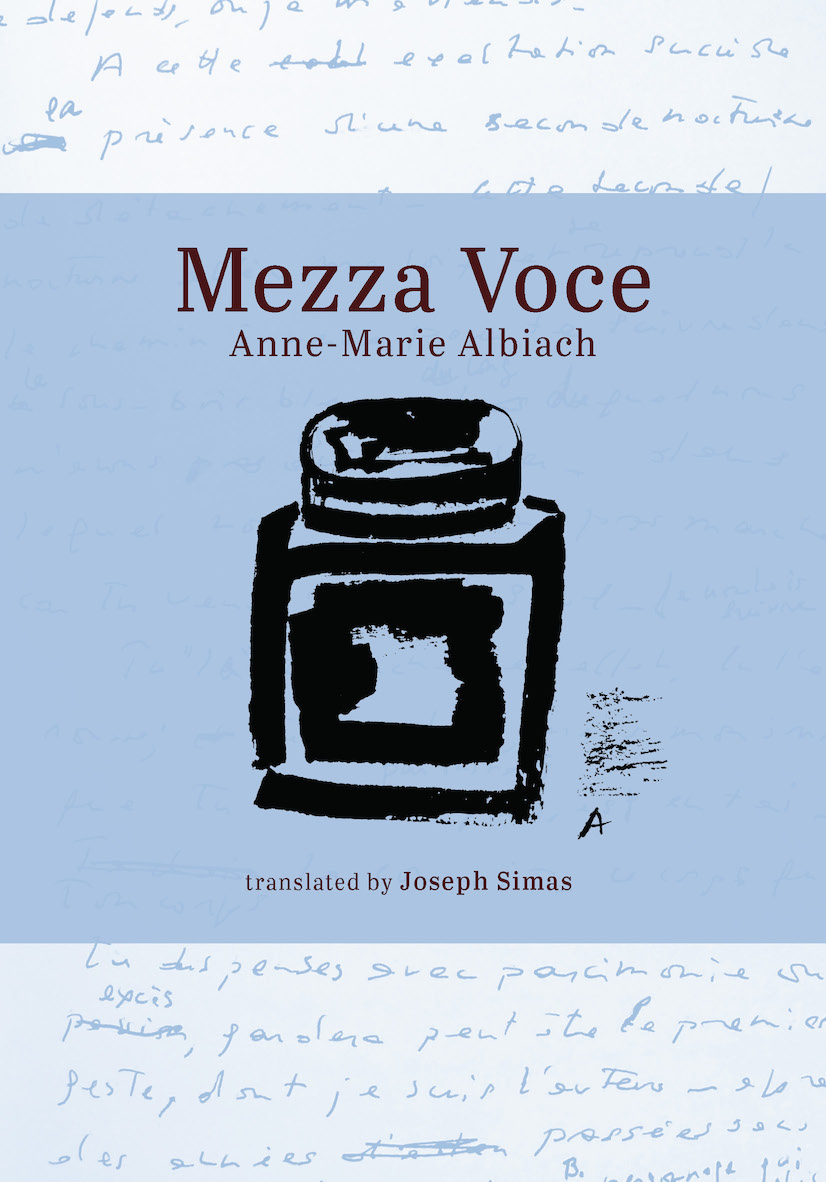
Anne-Marie Albiach’s second full-length book to be published in French and her first in English translation, Mezza Voce (Flammarion, 1984; The Post-Apollo Press, 1988) showcases Albiach at the height of her poetic powers, as she develops the minimalist poetics of earlier works like ÉTAT into what Michael Palmer calls “a true theater of the page.” Mezza Voce is translated by Joseph Simas in collaboration with the author, Anthony Barnett, Lydia Davis, and Douglas Oliver. This second edition is presented with a new introduction by Ann Smock and is published simultaneously with The Mezzanine in a new translation by Teresa Villa-Ignacio. As Paul Auster writes: “There is no other poetry like this in the world.”
Anne-Marie Albiach
Joseph Simas
Praise for Mezza Voce, 2nd Edition
If we can imagine the words themselves finding voice, becoming the persons of the poem, then perhaps we can begin to appreciate Albiach’s accomplishment. Mezza Voce represents a true theatre of the page, the realization of one of this century’s grand designs, desires in language “taking their place.”
— Michael Palmer
“I live the text as a body,” says Anne-Marie Albiach. She lives it literally, in the physical context of breath, of voice, of syntax as a physical next-to-each-other of words broken off by silence, the edges rough, giving off sparks like live wires. She lives it also as the enigma of desire, the “inexhausible novel” of drive and impulse. Her words are “engendered” by coupling words, and song becomes blaze, or “incantescence.” It’s high time that this important French poet is published in English.
— Rosmarie Waldrop
After living with the original French versions of these poems for many years, I was astonished to see how closely the translations by Joseph Simas and his collaborators capture the spirit of Anne-Marie Albiach’s work: its tone, its intensity, its brilliance. There is no other poetry like this in the world. Even at its most difficult, its passions are mesmerizing. It is a great triumph to have carried these extraordinary pages into the English language.
— Paul Auster
Here is the poet for whom the voice itself rings in its silent echo, reaching ever farther into the constancy of reflection, ever further into something unknown, unknowable, frightening…
— Gale Nelson, Cathay
It is a book of fourteen poems… which seem to be a meditation on an already-distanced interior drama, a kind of passion both in the sensual and in the suffering senses.
— Rachel Blau DuPlessis, Temblor