
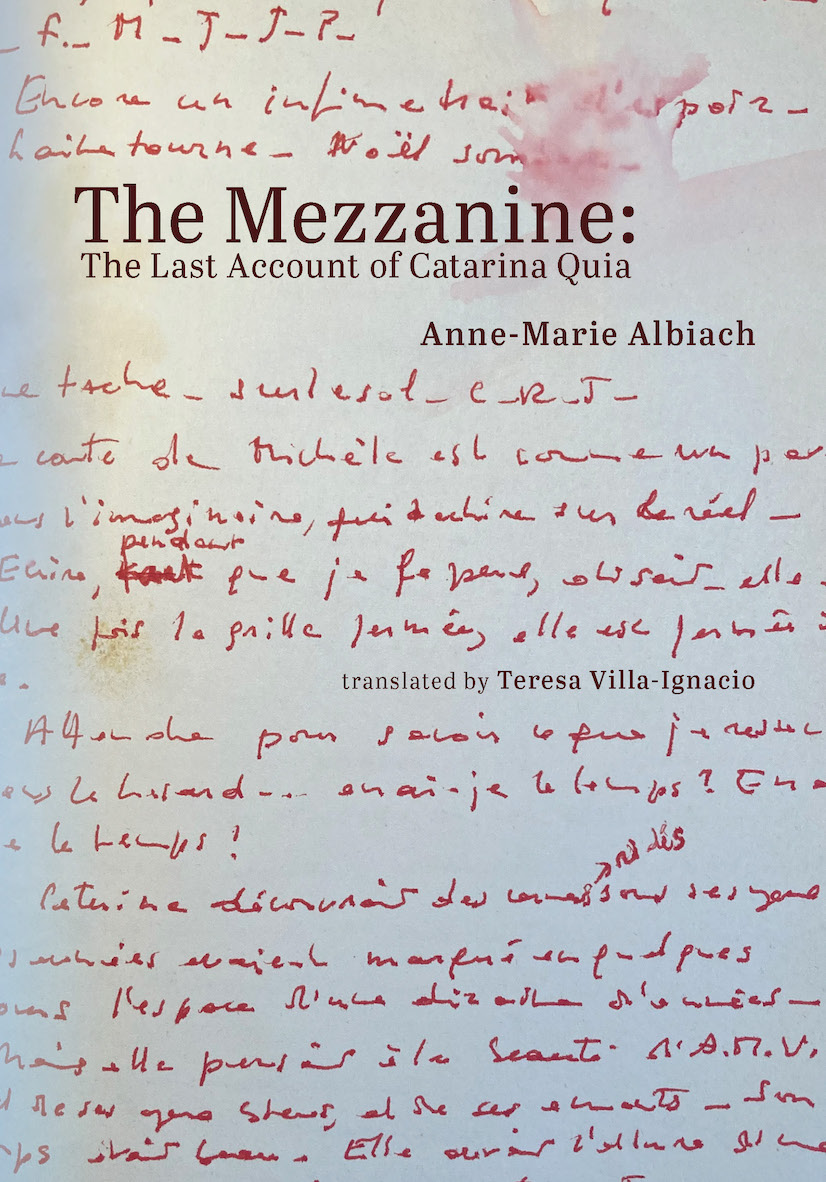
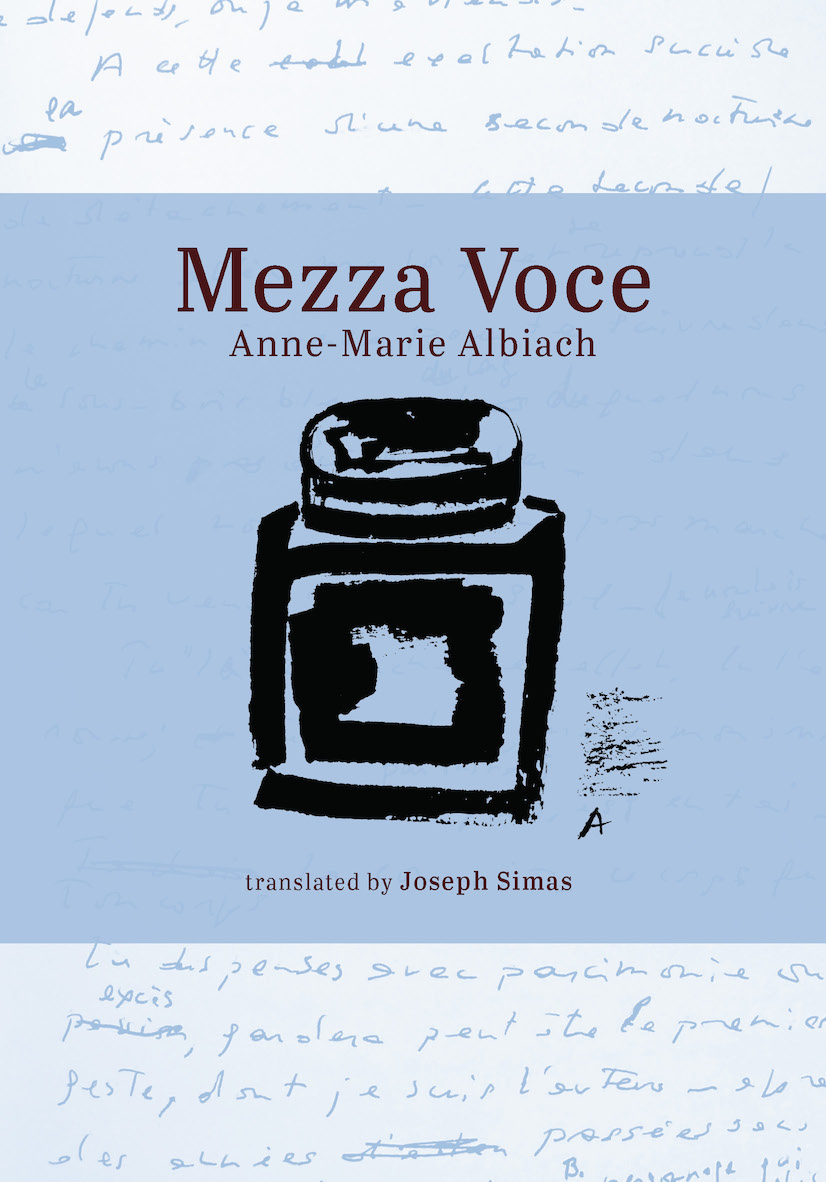
Startling and audacious in its vulnerability and poetic beauty, this lone novel by the beloved French poet Anne-Marie Albiach was published posthumously in France in 2019 to great critical acclaim. The Mezzanine is presented here in English for the first time in a new translation by Teresa Villa-Ignacio and with an introduction by Cole Swensen. This publication coincides with a new second edition of Albiach’s first volume of poetry published in English translation, Mezza Voce (translated by Joseph Simas, The Post-Apollo Press, 1988; Litmus Press, 2026). As Rosmarie Waldrop writes, “In this, [Albiach’s] only novel, the fragmentation allows us to glimpse her Season in Hell: she feels trapped in a psychiatric clinic and struggles with anxieties and identity. Stronger than her fear of death is the fear of being unable to write. For it is writing that enables her to endure—and to give us this extraordinary, enigmatic novel about suffering.”
Anne-Marie Albiach
Teresa Villa-Ignacio
Praise for The Mezzanine
Quia: because or since. My herself, “and found herself in the lines.” She writes with “her watch and the scars on her wrist.” As Claude Royet-Journoud penned, “the generation is in the sentence.” Tempting and tuning time, assuming time, Anne-Marie Albiach writes the body with the body. With names of people and objects, simple multiples propose a detective story in ecstatic mourning. As soon as she begins to write, these adrenaline meditations become fiction, practicing the present in transitive acts. If her books of poetry are vertical or spiral, this récit, this account is an astonishing work of mirroring, of syntactical surface-to-air horizontality, invisible numbers on a necklace charting depth of field. What is in play is play itself. Like Edith Piaf, Albiach writes, “je ne regrette rien.” “I regret nothing.” Teresa Villa-Ignacio translates The Mezzanine brilliantly.
— Norma Cole
A spectacular interior monologue seen from a mezzanine overlooking a stage — or from a stage looking at a scene on a mezzanine — or the spectacle shattered by words. The delirious enigma of anxiety’s split desires: subject/object. A masterpiece of unmastering. With thanks to Teresa Villa-Ignacio for a haunting translation.
— Charles Bernstein
The brilliant French poet, Anne-Marie Albiach, has always confronted the menace of death by incorporating its silence into her texts: blank space, phrases broken off, making for tension and “incantescence.” In this, her only novel, the fragmentation allows us to glimpse her Season in Hell: she feels trapped in a psychiatric clinic and struggles with anxieties and identity. Stronger than her fear of death is the fear of being unable to write. For it is writing that enables her to endure—and to give us this extraordinary, enigmatic novel about suffering. Its many memorable phrases will stay with you: “Catarina Quia lives in the alternative to herself.” Or: “to say I, I must touch my body.” Teresa Villa-Ignacio has translated the book with precision and remarkable sensitivity.
— Rosmarie Waldrop
No set of synonymic adjectives can describe this novel, these notebooks. Harrowing, heartbreaking; dazzling, luminous. A work of madness; a work of genius. Syllogistic Nijinskian diary. A chasm and a cloud. “Read the Mallarmé finally. A lightning estrangement of the I in time – and of the ego and of time.” Out of an unfixed trefoil knot of character/narrator/author rushes a prose of extreme urgency, an unceasing oscillation between murky viscosity and crystallographic concretion. “An ascendancy of symbols, soliloquy, and déjà vu.” A world of entropy, enthalpy, phase states. Is this book the obverse of Albiach’s poetry, or is it a foundation, or puzzling coextension, or an outcropping? In the suffering and bare life, the abjected circling will open onto incandescent images; haunted confusion, ontological fretwork, a searingly clear intelligence. “She … still didn’t know whether tomorrow she could again take up the thread of this geometry she named Mezzanine.” And yet, here. The novel is a masterpiece, the translation, a triumph. This object as a whole, with its gorgeous buttresses, is both profoundly tender and a total tour de force. It is a work of true love.
— Kevin Holden


Read an excerpt from The Mezzanine on Asymptote‘s Translation Tuesday feature.